|
This page presents purpose and outline of TeraMatsu's Technical Proposals.
1.Purpose of Technical Proposals
During the proposer's fifty years life specialized in engineering various hydraulic steel structures,
he has encountered many splendid technologies and also developed his owns.
Some of these technologies seem to have got more important since recent change in the social need.
This web site intends to publicize them more and contribute to the worldwide repletion of social overhead capitals.
2.Conditions and Estimation Methods of Technical Proposals
The technical proposals of this site are expected to be helpful for the administration officers to get beneficial solutions of their subjects on social overhead capital preparation.
For this reason, it is understood that the proposals shall satisfy following conditions.
1) The proposals have merit which any taxpayer can accept easily.
2) The proposals have no risk which prevents them from being realized.
3) The remained subjects in the proposals have to be explained as much as possible.
Followings are detail explanation of above three conditions and their estimation methods.
(1)Merit which any taxpayer can accept easily
It is understood that taxpayers would easily accept the proposals if their merit was remarkable. A merit criterion is required to make a suitable technology selection.
Cost, function and reliability were selected as the major merit elements for the comparison between a proposed technology and the ordinary one.
Established selection criteria for proposing technologies are as follows.
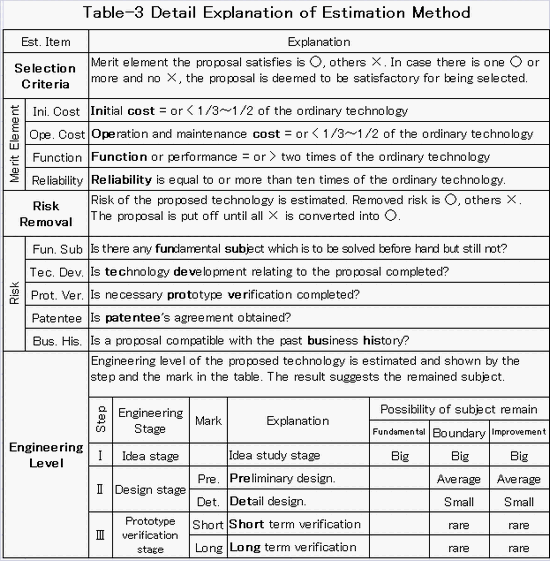
1) Cost: To be equal to or less than 1/3~1/2 of the ordinary one.
or,
2) Function: To be equal to or more than twice of the ordinary one.
or,
3) Reliability: To be equal to or more than ten times of then ordinary one.
Each criterion is applicable independently with the condition that another two elements are at least the same level as the ordinary technology.
The cost criterion 1) is applied separately to the initial cost and the operation cost including maintenance, and the function includes the performance.
It was concluded that the selection criteria are only aim and their moderate application including other merit elements is preferable.
(2)Risk which prevents proposals from being realized
The opening to the public of a technical proposal which satisfies the selection criteria has no meaning if there is risk which prevents the proposal from being realized.
There will be two kinds of risk, i.e. "technical" and "social." The technical risk is, for instance, due to an incomplete technology or insufficient verification and the social risk comes from human relation.
Participants of technical development is usually quite many in their number. And the most of technology has been brought up by cooperation of customers and enterprises even if their seed belongs to an individual.
To open a technology to the public with private means like this site shall not permit any participants to loose their gain.
Followings are example of queries to estimate the risk removal.
1) Technical risk
・Is there any fundamental subject which is to be solved before hand but still not?
・Is technology development relating to the proposal completed?
・Is necessary prototype verification completed?
2) Social risks
・Is patentee's agreement obtained?
・Is a proposal compatible with the past business history?
(3)The remained subject
A proposed technology is supposed to have no unsolved fundamental subject but boundary or improvement subjects which will not control its feasibility can remain without their solutions.
That is because resolution of the secondary subjects is foreseeable, but information about them is very important for the administration officers.
In stead of giving these information directly, engineering level of the proposed technology is presented with the three step method shown below.
A concrete content of a subject will be shown on the detail page of each technical proposal.
LevelⅠ:Idea stage・・・・・・・・・・・・・・・・・・・・・・・・・・・・・・・The fundamental subjects may remain.
LevelⅡ (Pre.):Design stage (Preliminary design)・・・・・・・・The secondary subjects may remain.
do (Det.):Design stage (Detail design)・・・・・・・・・・・・・Improvement subjects may remain.
LevelⅢ (Short):Prototype verification stage (Short term)
do (Long):Prototype verification stage (Long term)
3.Outline of Technical Proposals
|