|
A technical proposal on super large storm gates of membrane structure is under consideration.
More study is necessary on fundamental subjects and reliability improvement of the gate. Details are as follows.
1.Estimation of Proposed Technology
The result of estimation on the top page is as follows.
(1)This technology is deemed not to be satisfactory for a technical proposal. Its reason is,
1) The initial cost is equal to or less than 1/3~1/2 of the ordinary technology
2) But, the reliability of this technology is much less than ordinary technologies.
(2)Still there are risks which prevent the proposal from being realized. Details are as below.
1) A fundamental subject which has not been solved still exists. (Fun. Sub.)
2) Necessary prototype verification has not been completed. (Pro. Ver.)
3) The patentee's agreement has not been obtained. (Patentee)
4) Interests of the beneficiaries coincide with the proposer's. (Bus. His.)
(3)The engineering level is Ⅰ(Idea stage).
2.Realization of Membrane Storm Gate
Important technical points in realizing a storm gate of membrane structure are presented.
(1)Operability of Membrane Gate
The most important subject in realizing a large membrane storm gate is good operability which means that the gate can close or open the waterway quickly.
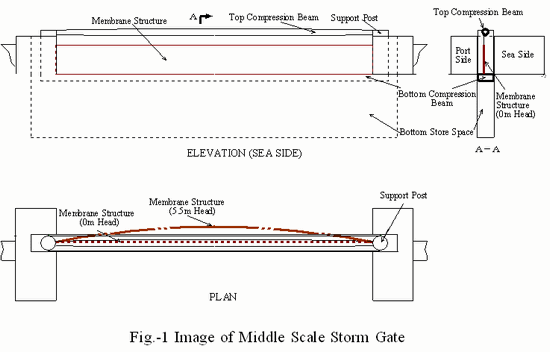
Fig.-1 shows image of middle scale storm gate.
Its clear span is 75 meters, its membrane structure is stored under the sea bottom when the waterway is opened and its quick operability will be realized by following device.
1) The top and bottom compression beams and the two support posts at both ends of the beams
are rigidly connected and constitute a strong framework.
2) The membrane structure stretched between the posts is in strain condition (being tensed
by the posts).
3) The membrane structure and the framework float together vertically to close the waterway
by buoyancy air put into float tanks of the framework.
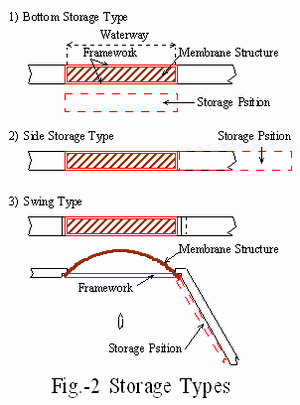
Although above devise concerns the sea bottom storage type, Fig.-2 shows other storage types.
(2)Prevention of Membrane from Floating
A Membrane in water yields tension and deforms archwise in horizontal plane due to water pressure acting on it.
The deformation volume is not vertically constant and there is tendency that it is small in the vicinity of the sea surface and large at the sea bottom.
The membrane gets buoyancy force due to the deformation and its bottom starts rising and leakage may occur.
Fig.-3 shows an inclined gate guide surface of a concrete pier.
The support post touches with the inclined guide surface due to water pressure working on the membrane and the membrane changes its position downward with a result that the water pressure acting on the membrane changes its direction downward and eventually prevents the membrane bottom from rising.
(3)Countermeasure for Reduction of Tension Force in Membrane
As the membrane structure between the support posts is given strain initially, volume of the membrane deformation keeping the balance of the working water pressure is less than the volume without initial strain. As the membrane tension force is eventually more than the case without initial strain, corresponding construction cost gets more.
As the cost increase rate is little in case of a large scale storm gate but may be fatally much in a small scale case, countermeasures of tension force reduction are necessary.
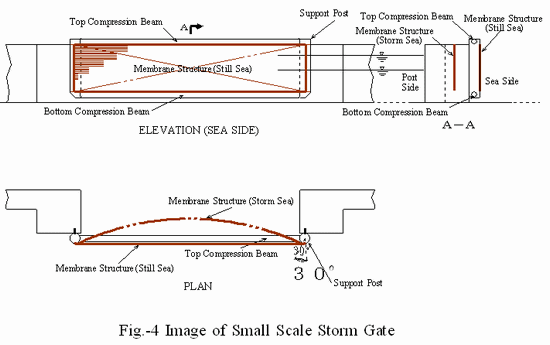
Fig.-4 shows image of a small scale storm gate.
Its clear span is 30 meters, its main purpose is to still a port water surface against sea waves and its force reduction will be realized by following device.
1) The membrane structure stretched between the support posts of the framework is in strain
condition.
2) The membrane is pulled out by a fixed length with rotation of the posts when the membrane
force exceeds a fixed value.
3) The membrane is rolled up when the membrane force gets less than a fixed value.
In this case, the span center's membrane deformation corresponding to the fixed length of pulling out is 10 % of the clear span whereas the force reduction rate attained is 60 % and the post rotation angle corresponding to the fixed length of pulling out is only 30 degrees.
|